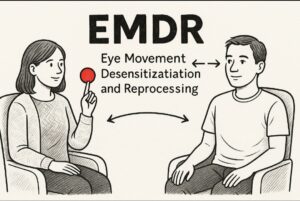
Wondered what EMDR is? Been hearing more about it recently?
Not surprising, as this very useful therapy is garnering respect and favourable feedback on it’s success rates. Such is it’s efficiency that it is used by the Armed Forces, Navy and Emergency services.
So what is EMDR?
It stands for Eye Movement Desensitisation and Reprocessing. As it’s acronym suggests with the use of eye movement, it helps reduces; trauma, anxiety and negative self beliefs to nil. And all the latter is reprocessed into something positive and healing.
An obvious question that is asked is whether it is similar to hypnosis; especially with the eye movement involved. Hypnotherapy invites us into a hypnogogic state, where we are in a Theta wave like state of mind- which is that stage we are in between being awake and dropping off to sleep. EMDR may mimic elements of sleep but more along our REM sleep – Rapid Eye Movement that happens in sleep– but while you are awake.
What is REM sleep you might ask?
Have you ever noticed when people are in deep sleep/dream sleep, one can notice that their eyes move from side to side under their closed eye lids. Now, having worked as a therapist for two decades I really believe that this is a much needed physical exercise that enables us to catalogue our waking experiences. Dreams are the much needed processors and psychical healers. I call dreams the ‘Night Secretary’, busy cataloguing our experiences in our very own unique and personal filing system.
So how come moving our eyes laterally side to side activates shifts and moves our psyche. It helps to activate the amygdala and hippocampus in the least disturbing way. You may have noticed when we are walking or moving outside, we scan our environment and look side to side. This is our way of registering danger and activating the amygdala.
So let us look at how the brain works and then describe how EMDR can relieve us from trauma, anxiety and negative self beliefs.
The amygdala, known as the processor of emotions, is linked to other important parts of the brain such as memory, learning and senses. Albeit a small, almond shaped, part of the brain, it plays an important role to the larger system; the limbic system, also known as the emotional brain. The amygdala helps detect danger and alerts us, reminding us of whether we were in a similar incident and need to be cautious.
Recent research now informs us that the amygdala has many more foundational uses for us. It is like a formidable interpreter / builder / body guard. It helps with aggression, learning whether situations are rewarding, best left aside or if they are punishing or dangerous.
Amongst other many important skills, the amygdala is also responsible for learning implicit skills such as brushing our teeth, tying our shoe laces, riding a bike and other very useful skills, such as reading people’s emotions, reactions and actions. These then are linked to memory part of our brain.
This very proficient complex matrix of skills is also primarily there to protect us as a clever survival kit. With the link to memory, it is even more powerful whilst helping us to decipher what we need to be wary of and ready for. This is were traumatic memories come in.
Traumatic memories have huge impact and, in order to avoid ignoring the signs again, it leaves synaptic traces. Thus, loading up on how one translates events or traumas, like deep fissure or grooves that are like road signs indicating danger.
The beauty of EMDR is that it decreases the volatility of the awful memory whilst preserving the full function of the hippocampus. How does the hippocampus serve us, you may ask? The hippocampus is the retriever of memories, like a librarian that can categories short and long term memories: quickly organising and collecting the memory for you to work with.